
The “M” on the Palm: What Palm Lines Really Mean
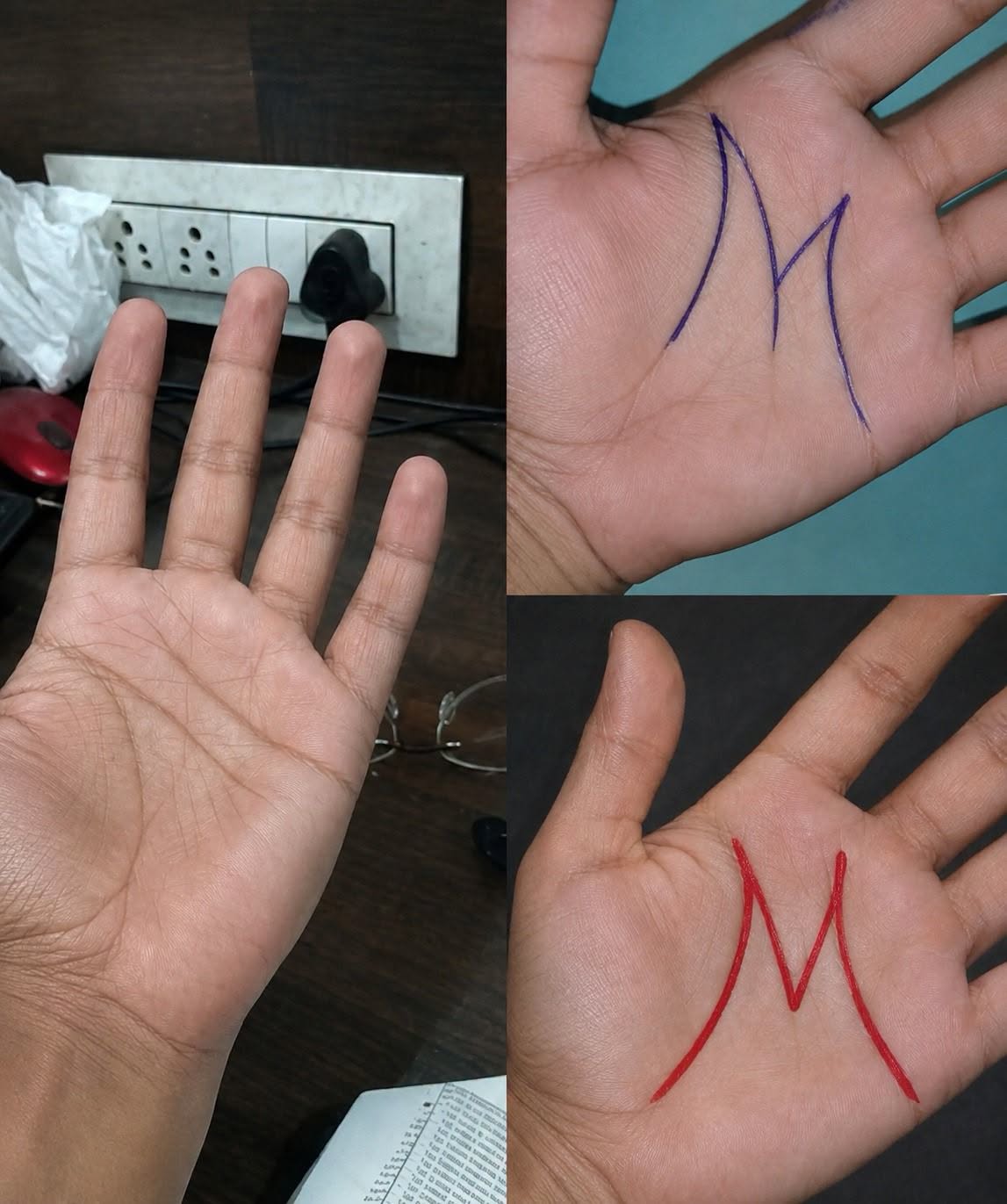
The human palm contains a fascinating network of natural creases and lines that develop as the hands grow. Because these patterns can look remarkably distinctive from person to person, they have attracted attention for centuries. One popular topic in palmistry is the supposed appearance of the letter “M” formed by several major lines on the palm. Images circulating online often highlight these lines with colored ink, as in the photograph shown here, to make the shape easier to see.
The important distinction is between what the lines physically are and what palmistry claims they represent. From an anatomical and scientific perspective, the lines on the palm are normal skin creases. Their patterns are influenced by genetics, development, hand movement, and the way the skin folds repeatedly. From the perspective of palmistry, however, particular lines have traditionally been assigned symbolic meanings relating to personality, relationships, intelligence, career, fortune, or other aspects of life.
The most commonly discussed palm lines include the heart line, head line, life line, and fate line. The heart line generally runs across the upper portion of the palm beneath the fingers. Palmists traditionally associate it with emotions, relationships, and matters of the heart. The head line usually extends across the central portion of the palm and is interpreted in palmistry as representing thinking, communication, and intellectual tendencies. The life line curves around the base of the thumb. Despite its name, it does not scientifically indicate how long a person will live. The fate line, when present, may run vertically toward the middle finger and is traditionally associated with career or life direction.
The supposed “M” is not actually a separate anatomical structure. It can appear when several natural creases intersect or approach one another in a particular arrangement. Depending on the individual palm, the lines may create something that resembles an M, a W, a series of arches, or another recognizable shape. People sometimes trace these lines with a pen or marker to emphasize the pattern, making the letter appear much more obvious than it does naturally.
Palmistry assigns different interpretations to an M-shaped formation. Some palmistry traditions describe it as a sign of strong intuition, determination, leadership, honesty, financial ability, or an ability to recognize opportunities. Other interpretations claim that people with such markings possess unusual insight or are particularly good at judging other people. These claims can vary considerably between palmistry traditions and practitioners.
There is, however, no reliable scientific evidence that an M-shaped palm pattern predicts personality, intelligence, wealth, career success, relationships, or future events. Palm creases do not contain a scientifically established system for forecasting a person’s future. Two people can have remarkably similar palm patterns while having completely different personalities and life experiences.
The fascination with palm markings nevertheless has understandable origins. Human beings naturally search for patterns and meaning. When a familiar letter appears in an otherwise random-looking structure, the brain tends to notice it immediately. This phenomenon is related to pareidolia, the tendency to perceive recognizable forms in ambiguous or complex patterns. We see faces in clouds, shapes in rock formations, and letters in natural arrangements. An M-shaped palm can similarly become especially noticeable once someone points it out.
Another reason these claims can feel convincing is that palmistry interpretations are often broad enough to apply to many people. Statements such as “you are intuitive,” “you value honesty,” or “you have leadership potential” can sound personally accurate because they describe qualities that many people recognize in themselves. This psychological phenomenon is sometimes associated with the Barnum effect, in which general descriptions are perceived as highly specific or personally meaningful.
The physical palm itself is nevertheless medically and biologically interesting. Palmar creases develop during fetal development and help the skin accommodate repeated movements of the hands and fingers. Most people have multiple creases arranged in broadly similar locations, although the exact patterns differ. Some people have variations in the number, depth, or configuration of these creases. A single prominent transverse crease, for example, is sometimes called a single transverse palmar crease. Such variations are often completely harmless, although in certain medical contexts doctors may consider them alongside many other physical findings. A palm crease by itself should not be used to diagnose a disease or medical condition.
The photograph shows hands with colored markings drawn over selected creases. These markings appear intended to emphasize particular lines and demonstrate how they can be interpreted as forming a particular shape. The ink itself is not part of the natural palm structure. If someone is examining their own palm, it is therefore important to distinguish between the actual skin creases and any lines that have been added with a pen, marker, or editing software.
It is also worth remembering that palm lines can change subtly over time. Skin becomes thicker or thinner, dryness can make creases more prominent, and repeated hand movements can affect their appearance. Injuries, scars, calluses, and other skin changes can also alter the visual pattern. These ordinary biological changes do not mean that a person’s destiny has changed.
Palmistry can certainly be approached as a cultural tradition, historical practice, or form of entertainment. Many people enjoy comparing palm interpretations with friends or exploring how different cultures have understood the hand. The problem arises when symbolic interpretations are presented as established medical, psychological, or scientific facts. Claims that a particular palm marking guarantees wealth, predicts marriage, determines intelligence, or reveals future events should therefore be treated as beliefs rather than scientifically demonstrated conclusions.
The “M” on the palm is consequently best understood as an interesting visual arrangement of normal palm creases. Some people may find personal or cultural meaning in it, while others may simply appreciate the unusual pattern. What the photograph demonstrates most clearly is how easily several natural lines can be emphasized to create the appearance of a recognizable letter.
Ultimately, the shape of a person’s palm does not determine who they are or what their future will be. Personality develops through a complex combination of biology, experiences, relationships, environment, learning, and individual choices. Careers and relationships likewise depend on circumstances and decisions rather than on a particular arrangement of skin creases. The M-shaped palm may be visually intriguing, but its significance is cultural and symbolic rather than a scientifically established method of predicting a person’s life.

