
Hard Bumps on Finger Joints Near the Nails: Causes, Symptoms, and Treatment
Introduction
Hard bumps that develop on the finger joints near the nails can be concerning, especially when they appear on several fingers or seem to become larger over time. These bumps are relatively common in older adults and may be associated with age-related joint changes, osteoarthritis, or other conditions affecting the skin and joints.
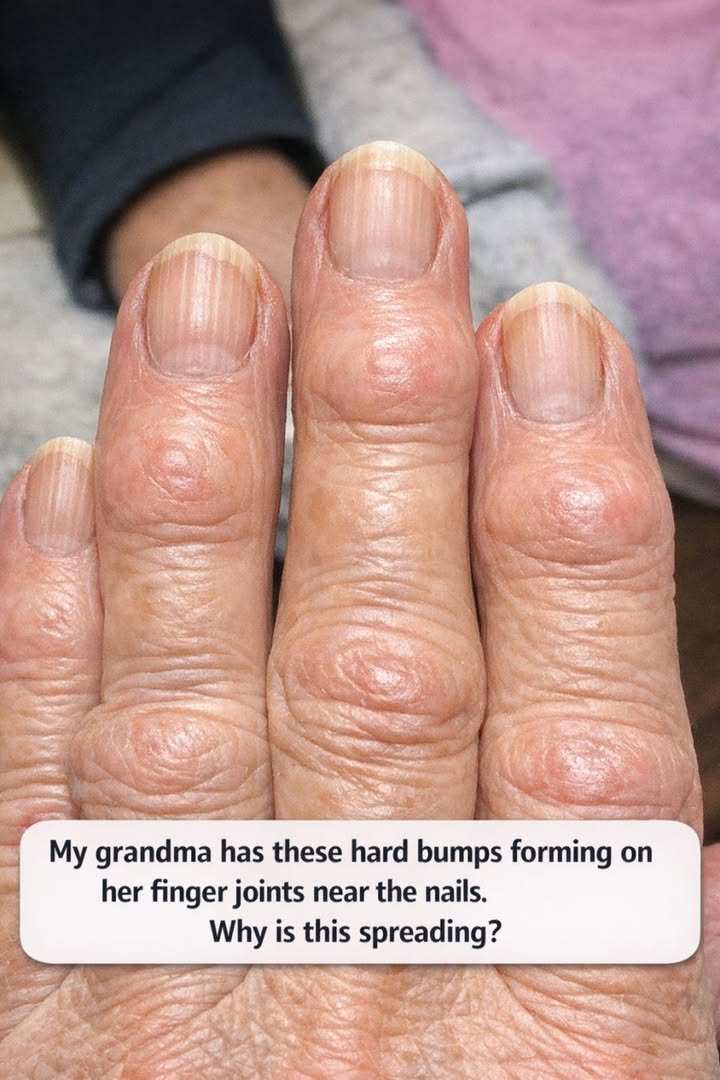
As shown in the picture, there are raised areas around several finger joints. One possible explanation is Heberden’s nodes, which are hard, bony enlargements that develop at the distal interphalangeal joints, the joints closest to the fingernails. However, other conditions can cause similar-looking bumps, so an image alone cannot establish the exact diagnosis.
Understanding why these bumps form, why they may appear on multiple fingers, and when medical attention is needed can help people make informed decisions about their health.
This article explains the possible causes, common symptoms, diagnosis, treatment options, and practical steps that may help protect finger-joint function.
Step 1: Understand What These Hard Bumps May Be
One common cause of hard bumps near the fingernails is a condition known as Heberden’s nodes.
Heberden’s nodes are firm enlargements that develop around the small joints at the ends of the fingers. They are commonly associated with osteoarthritis, a condition in which the tissues and structures within a joint gradually change over time.
As osteoarthritis develops, the cartilage that helps the joint move smoothly may deteriorate. The body can respond by forming extra bone around the joint margins. These bony changes may become visible or feel like hard lumps beneath the skin.
Heberden’s nodes are often more noticeable in older adults. They may affect one finger or several fingers, and they can occur in both hands.
Although the bumps may look unusual, their presence does not automatically mean that a person has a serious medical condition. A healthcare professional can examine the joints and determine whether osteoarthritis or another problem is responsible.
Step 2: Learn Why the Bumps Develop
There is no single explanation for every hard bump on a finger joint. Several factors can contribute to the development of joint enlargements.
Osteoarthritis
Osteoarthritis is one of the most common causes of hard enlargements near the ends of the fingers. Changes in cartilage and bone can lead to stiffness, tenderness, reduced movement, and the formation of bony nodes.
The bumps may become more noticeable gradually, sometimes over months or years.
Age-related joint changes
The likelihood of developing osteoarthritis generally increases with age. Repeated use of the hands over many years may contribute to joint symptoms, although ordinary hand use alone does not necessarily cause osteoarthritis.
Family history
Genetics can influence a person’s likelihood of developing finger-joint osteoarthritis. Some families have a greater tendency to develop Heberden’s nodes, and inherited factors may help explain why several relatives experience similar changes.
Previous joint injury
An old injury involving a finger joint can sometimes contribute to later joint degeneration. However, not every person with finger bumps has experienced an injury.
Other joint conditions
Inflammatory arthritis, including rheumatoid arthritis and psoriatic arthritis, can also affect the fingers. These conditions may produce swelling and changes in joint shape, although their patterns and underlying causes differ from those of typical osteoarthritis.
Step 3: Understand Why the Bumps May Be Spreading
When someone notices hard bumps appearing on several fingers, it may seem as though the condition is spreading from one joint to another.
In osteoarthritis, however, the process is not usually an infection spreading between fingers. Instead, multiple joints may develop changes because they share risk factors such as age, genetics, and underlying joint susceptibility.
A bump may first appear on one finger and later become noticeable on another. This can happen because osteoarthritis can affect several joints independently.
The bumps may also become more prominent as bony changes develop over time.
It is important to distinguish between gradually developing hard enlargements and rapidly appearing swelling. Sudden swelling, significant redness, warmth, or severe pain may indicate a different problem that requires prompt medical evaluation.
Important: If the bumps are growing quickly, are unusually painful, or are accompanied by other symptoms, arrange a medical assessment rather than assuming they are simply age-related changes.
Step 4: Recognize the Common Symptoms
The symptoms associated with finger-joint bumps vary according to their cause.
Common features of Heberden’s nodes include:
Hard lumps around the joints closest to the fingernails.
Gradual enlargement of the affected joints.
Stiffness when bending or straightening the fingers.
Discomfort when gripping objects or performing household activities.
Occasional tenderness or swelling, particularly during periods of inflammation.
Changes in the appearance or alignment of the fingers.
Some people experience very little pain despite having noticeable bumps. Others may experience discomfort, especially when the joint is irritated.
Morning stiffness can occur with osteoarthritis, but prolonged stiffness or swelling in several joints may suggest another type of arthritis.
The appearance of a bump alone is not enough to determine which condition is present.
Step 5: Know When Medical Attention Is Necessary
A healthcare professional should examine persistent or unexplained bumps, particularly when they are appearing on several fingers.
Seek urgent medical attention if a finger joint becomes suddenly very painful, hot, red, and swollen, especially if there is fever or the person feels generally unwell. These symptoms can indicate an infection or another acute joint problem.
A medical appointment is also important when the bumps interfere with daily activities, the fingers become increasingly stiff, or the joints change shape noticeably.
Other warning signs include unexplained swelling in multiple joints, prolonged morning stiffness, or skin changes around the affected areas.
Early assessment can help identify the cause and guide appropriate treatment.
Step 6: How Doctors Diagnose Finger-Joint Bumps
Diagnosis usually begins with a medical history and physical examination.
The doctor may ask when the bumps first appeared, whether they are painful, whether they have changed in size, and whether other joints are affected. A family history of osteoarthritis or inflammatory arthritis may also be relevant.
During the examination, the doctor may assess the joints for tenderness, warmth, swelling, range of motion, and the location of the lumps.
X-rays
An X-ray may be recommended when osteoarthritis is suspected or when the diagnosis is uncertain. It can show changes such as joint-space narrowing, bony enlargements, and other features associated with osteoarthritis.
Blood tests
Blood tests are not always necessary for typical osteoarthritis. However, they may be useful if the doctor suspects rheumatoid arthritis, another inflammatory condition, or a different underlying problem.
Examination of the skin
Some bumps near the fingernails are not primarily caused by arthritis. For example, digital mucous cysts are fluid-filled lumps that often develop near the end joints and may occur alongside osteoarthritis.
A doctor can help distinguish these cysts from bony nodes, skin lesions, and other causes.
Step 7: Treatment Options for Hard Finger-Joint Bumps
Treatment depends on the diagnosis, the severity of symptoms, and how much the condition affects daily life.
There is currently no treatment that reliably removes all osteoarthritis-related bony enlargements without an appropriate medical procedure. However, several approaches can help reduce discomfort and maintain function.
Warm compresses
Applying a comfortably warm compress may help relieve stiffness. Use it for approximately 10–15 minutes, making sure it is not hot enough to burn the skin.
People with reduced sensation or circulation problems should take extra care with heat.
Gentle finger exercises
Gentle movements can help maintain flexibility. Slowly bending and straightening the fingers within a comfortable range may be useful.
Do not force a stiff joint or continue an exercise that causes significant pain. A physiotherapist or occupational therapist can recommend exercises suited to the person’s condition.
Pain-relieving medication
A doctor or pharmacist may recommend an appropriate pain reliever. Topical anti-inflammatory medicines can help some people with hand osteoarthritis, but they are not suitable for everyone.
Oral anti-inflammatory medicines may carry risks involving the stomach, kidneys, blood pressure, and heart. Older adults should discuss these risks with a healthcare professional before using them.
Activity adjustments
Using larger-handled kitchen utensils, opening jars with assistance, and avoiding prolonged forceful gripping may reduce strain on painful joints.
Short breaks between repetitive tasks can also help manage symptoms.
Medical procedures
If a bump is actually a mucous cyst rather than a bony node, a clinician may discuss specific treatment options. Procedures or surgery are generally considered only in selected cases when symptoms are persistent or function is significantly affected.
Do not attempt to puncture, squeeze, or cut a bump at home. This can cause bleeding or infection.
Step 8: Everyday Habits That Support Joint Health
Although lifestyle changes cannot guarantee prevention or reverse existing bony enlargements, several habits may support comfortable hand function.
Eat a balanced diet containing vegetables, fruits, whole grains, protein sources, and healthy fats. Adequate nutrition supports general health, although no particular food has been shown to dissolve Heberden’s nodes.
Maintain regular, gentle physical activity appropriate for your abilities.
Protect painful fingers from excessive strain while continuing comfortable everyday movement.
Avoid smoking, which is associated with several health problems and can affect overall tissue health.
If you have diabetes, circulation problems, or reduced sensation in your hands, check the skin regularly and seek advice about safe temperature use and skin care.
Do not rely on supplements marketed as cartilage regrowth treatments without discussing them with a qualified healthcare professional.
Step 9: Can These Bumps Be Prevented?
There is no guaranteed way to prevent Heberden’s nodes, particularly when age and inherited factors contribute to their development.
However, protecting the hands from injuries, using tools that reduce excessive gripping, and seeking appropriate care for persistent joint symptoms may help preserve function.
If osteoarthritis is diagnosed, a personalized management plan can help address pain, stiffness, and limitations in daily activities.
It is also important to remember that not every hard lump is an osteoarthritis node. Treating the correct underlying condition is more useful than trying to remove the visible bump without a diagnosis.
Step 10: Frequently Asked Questions
Are hard bumps near the fingernails dangerous?
Many are associated with benign joint changes, particularly osteoarthritis. Nevertheless, unexplained or changing lumps should be examined to confirm the cause.
Do Heberden’s nodes go away?
The bony enlargements associated with osteoarthritis generally do not disappear on their own. Pain and inflammation may fluctuate, and symptoms can sometimes be managed with appropriate treatment.
Why do older women sometimes develop these bumps?
Heberden’s nodes are common in older adults, and genetic factors may play a role. Women, particularly after menopause, have an increased prevalence of hand osteoarthritis, although the condition can affect anyone.
Can massage remove the bumps?
Massage cannot remove established bony enlargements. Gentle massage may feel soothing for some people, but avoid forceful pressure on painful or inflamed joints.
Do these bumps always mean arthritis?
No. Although osteoarthritis is a common cause, cysts and other skin or joint conditions can produce similar lumps. A medical examination is needed to distinguish between them.
Conclusion
Hard bumps on the finger joints near the nails may be Heberden’s nodes, which are often associated with osteoarthritis. They can develop gradually on several fingers because multiple joints may be affected by age-related changes and genetic susceptibility.
Although these bumps are not always dangerous, it is important to identify their actual cause. A healthcare professional may use a physical examination and, when appropriate, X-rays or other tests to establish the diagnosis.
Warm compresses, gentle movement, activity adjustments, and suitable pain-relieving treatments may help manage symptoms. However, established bony enlargements generally cannot be removed through home remedies.
If the bumps are spreading quickly, becoming increasingly painful, or accompanied by redness, warmth, or sudden swelling, seek medical advice promptly. The best approach is to confirm the diagnosis and choose treatment based on the person’s individual symptoms and health needs.
Health note: This article is for educational purposes and does not replace an examination or diagnosis by a qualified healthcare professional.

